
Global equity markets recorded their best quarterly performance since the initial post-covid lockdown rebound in the second quarter of 2020. The S&P 500 Net Total Return Index advanced 15.10% during the quarter[1] compared to 15.13% for the MSCI All Country World Index and 6.96% for the S&P/TSX Composite Index. Separately, the South Korean Kospi Composite Index delivered enough drama to rival the latest season of Squid Game with a quarterly performance exceeding 60% despite hitting numerous circuit breakers[2]. Most markets reached all-time highs even as consumer sentiment remained near recessionary levels as the dominant story was the extraordinary amount of capital flowing into artificial intelligence. Investors rejoiced but main street… not so much.
More than ever, the lines between politics and entertainment seemed indistinguishable as the White House briefly looked more like a pay-per-view venue than the seat of government when it hosted the UFC Freedom 250 event on the South Lawn. Elsewhere, the United Kingdom threw another prime minister in the woodchipper - the 6th prime minister not completing his or her term since Brexit. You get a free drink if you can name all of them…
In comparison to equity markets, the fixed income markets behaved more orderly during the quarter. The ICE BofA Canada Broad Market Index gained 1.92%, while the ICE BofA Global Government Bond Index and ICE BofA Global Corporate & High Yield Index gained 0.69% and 1.90%, respectively. Interest rates, which had subsided across the curve after bond investors concluded that Kevin Warsh was not as hawkish as feared, steadily increased until mid-may as the extension of the Iran war started to force inflation expectations upwards. After that, as it became clear that Washington was desperate to find a way out of that self-inflected mess, rates declined again.
More importantly, while the first FOMC meeting under Kevin Warsh[3] did not result in a hike or a cut, many were caught off guard by the new Chairman’s hawkish stance and his decision to de-emphasize forward guidance, putting an end to a tradition that started in 2003. If the Federal Reserve no longer signals to the market the future direction of rates to indirectly calm them and instead look for market signals to determine what to do next, it may reintroduce volatility to the fixed income markets.
Notwithstanding variations in Fed-speech, we note that as the conflict in Iran has resumed and oil prices are on an upward trajectory, interest rates have also been drifting higher. With that in mind, we may start wondering how great do AI-driven earnings have to be for equity markets to remain immunized from runaway yields.
MUCH ADOE ABOUT NOTHING[4]
On June 17th, U.S. President Donald Trump and Iranian President Masoud Pezeshkian signed a Memorandum of Understanding[5] (“MOU”) aimed at ending nearly four months of hostilities. Both sides immediately declared victory but, in the United States, both left-leaning and right-leaning media were rather consensual in how they called it: At best, it is an extended truce. At worst, an outright American capitulation.
Without much surprise, the agreement collapsed almost immediately as both sides accused each other of violating the 60-day ceasefire. Objectively, the MOU did little beyond reopening the Strait of Hormuz, which effectively meant restoring the status quo that prevailed on February 26th in exchange for the release of a portion of Iran’s frozen assets and the establishment of a $300 billion reconstruction fund. This is another way of saying that the United States bribed the world’s greatest exporter of terrorism to reopen the Strait. Fundamentally, it made the United States and Israel… less safe.
Other than that, the MOU left the whole nuclear question unresolved and gave Iran the flexibility to shut down the Strait of Hormuz again, at any time, should Israel and Lebanon exchange fire again. This was a fragile condition as neither Israel nor Lebanon were signatories to the MOU. Lastly, it did not explicitly name the countries that would fund the $300 billion reconstruction initiative. It stated that the United States would work with regional partners to develop a definitive funding plan but left the exact financing mechanisms and contributors to be finalized.
So, it is back to U.S. airstrikes, retaliatory Iranian drone strikes, and the reinstatement of sanctions. This is what winning by losing looks like. Nevertheless, the markets viewed the reopening of the Strait of Hormuz in late June as a positive, and the oil prices ended the quarter at a level close to where they were before the conflict erupted and inflation expectations came down rapidly.
The Republican spin doctors[6] have four months to convince voters that this outcome was a win for the United States. The polls suggest that they will unlikely succeed.
All in, it was not a good quarter for President Trump. He called the war over at least three dozen times only to see it continue the next day. He was booed at a New York Knicks game. His ideological ally Viktor Orban lost the Hungarian presidential election. A U.S. Court of International Trade judge ordered the Trump administration to issue refunds for sweeping tariffs that had been struck down as illegal by the Supreme Court earlier this year. A U.S District Court judge barred the administration from transferring money, reviewing claims, or disbursing money from his $1,776 billion “Anti-Weaponization Fund.” Another Judge ordered his name to be removed from the John F. Kennedy Center for the Performing Arts.
In the end, unable to advance any significant policy, Trump turned his attention to statues and monuments with equally horrid results. To this point, the Lincoln Memorial Reflecting Pool, whose renovation work was given to a Trump handpicked contractor, promptly turned into a green sludge which, for a moment, seemed like an entry point to the Upside Down[7]. Last but not least, the botched vinyl over the miniature plywood replica of the President’s proposed United States Triumphal Arch – which was supposed to be the most iconic attraction of the Great American State Fair – started to crack, peel, and leak polyurethane foam midway into the event and has become a vivid metaphor of a civilization that fails to incarnate its pretended greatness.
With the recent judiciary setbacks the Trump administration underwent and the midterms approaching, some observers argue that we may be beyond the point of peak Trumpism. That may very well be. But given Trump’s character and record, we can hardly count on a complete absence of disruption. The renewal of the United States-Mexico-Canada Agreement (“USMCA”) could provide Trump such an occasion. While Trump hasn’t invoked article 34.6[8] yet, he made it clear he no longer likes the deal he signed during his first term. Most analysts believe that a U.S. withdrawal is unlikely on the grounds that it would likely hurt republican states disproportionally. It is also unclear if Trump can unilaterally withdraw as the agreement was initially ratified by the Congress. As such, some argue that a withdrawal must also be passed by Congress. That said, given Trump’s general disregard for the legislative and judiciary institutions and his habit of going against common sense makes it a non-zero probability scenario.
WHY THE BEST HEDGE AGAINST AN AI BUST MAY RESIDE WITH ACTIVE EQUITY MANAGERS
“We may conceivably conclude from that vantage point that… the American economy was experiencing a once-in-a-century acceleration of innovation, which propelled forward productivity, output, corporate profits, and stock prices at a pace not seen in generations, if ever.”
This is not a recent quote from a Tech CEO. This is a quote from former Federal Reserve Chairman Alan Greenspan who passed away at 100 on June 22nd. These remarks were given in a speech before the Economic Club of New York on January 13, 2000, two months before the dot.com bubble crashed.
We believe these remarks provide a good context for what is happening today. The last leg of the current equity market rally has been driven overwhelmingly by one theme: The accelerating capital spending plans of the world's largest technology companies to build artificial intelligence infrastructure. That investment cycle has produced extraordinary earnings growth for semiconductor companies and the broader AI ecosystem. It has also become the dominant force shaping market leadership, index concentration, and investor positioning. While the fundamental story remains compelling, the market is beginning to display characteristics that are concerning.
First, in terms of percentage of Gross Domestic Product (“GDP”), the current AI build-out dwarfs all prior industrial booms that extended over many years, whether they were publicly funded like the Manhattan Project, the Marshall Plan, the national interstate highway system or the Apollo missions or were privately funded, like the railway mania of the nineteenth century, the radio, the personal computer, or the late-1990s fiber optic overbuild. The chart below from a recent Goldman Sachs report puts it in perspective. The firm estimates that $7.6 trillion will be spent from 2026 to 2031, which equates to 3% to 3.5% of GDP per annum, over 6 years.
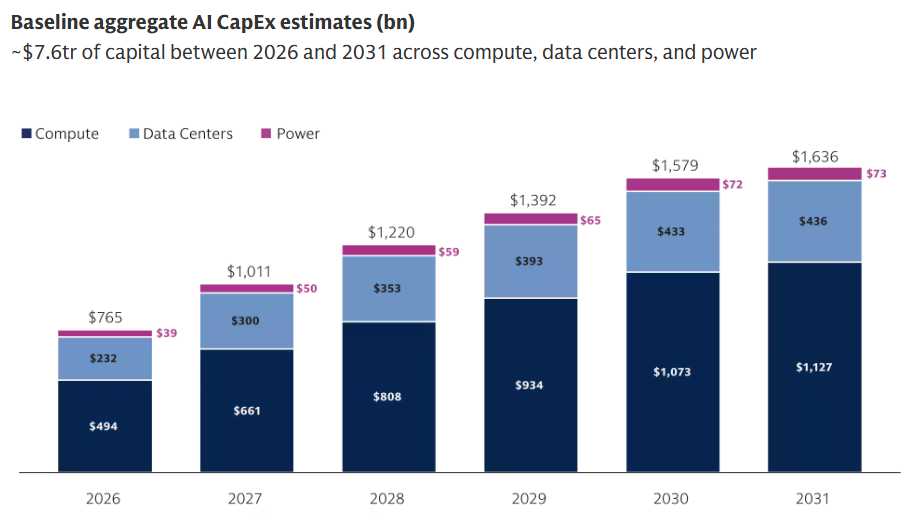
This does not prove that we are in the midst of an Artificial Intelligence (“AI”) bubble. The underlying businesses are generating real revenues and profits - a stark contrast from much of the dot.com era. However, history reminds us that periods of heavy capital investment always created excesses that only became apparent after the cycle matured. If the current boom does not end like these, it will be the first time.
Second, the leadership in the theme has switched from hyperscalers[9] to the semiconductor companies. Semiconductors are the ones to which the hyperscalers are writing checks to. They are akin to the companies that sold picks and shovels to gold miners during the Klondike mania. In fact, as pictured in the Bank of America chart below, semiconductors may be the recipients of the greatest free cash flow transfers in history. The Y-axis is in US$ billions.
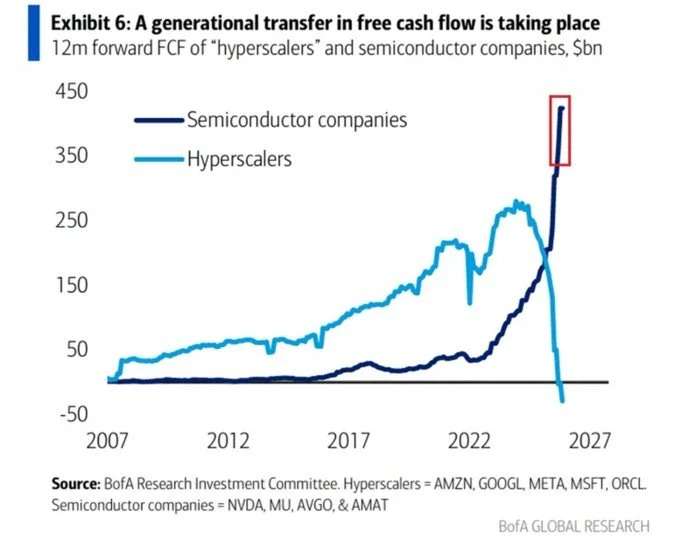
Naturally, investors have picked up on this, and semiconductor stocks have led global equity markets by a wide margin. The MSCI World Semiconductor & Semiconductor Equipment Index has risen more than 50% year-to-date through the end of June, more than 5x the return of the broader MSCI World Index. Valuations have consequently expanded toward the upper end of their historical range, with forward earnings multiples approaching 30x. Meanwhile, the Philadelphia Semiconductor Index is trading approximately 65% above its 200-day moving average — a level not observed outside periods of extreme market enthusiasm. In fact, aggregate inflows into Semiconductor Exchanged Traded Funds (“ETFs”) have no historical equivalent as can be seen in the next Bank of America chart below.
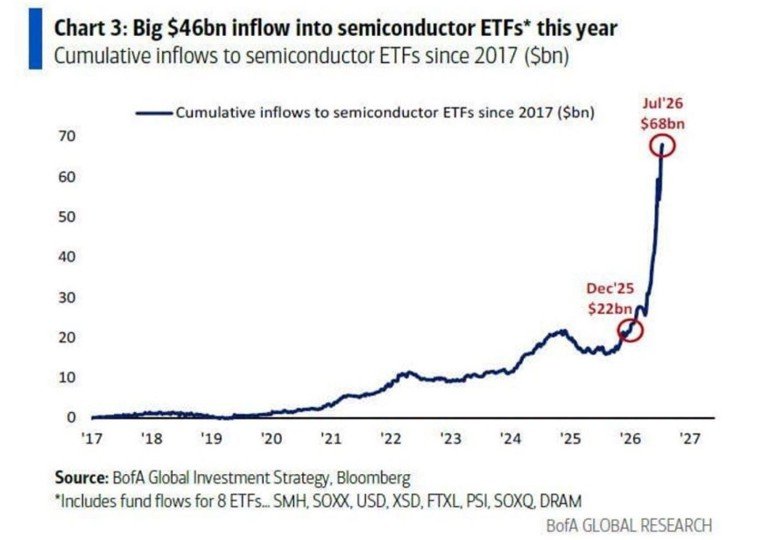
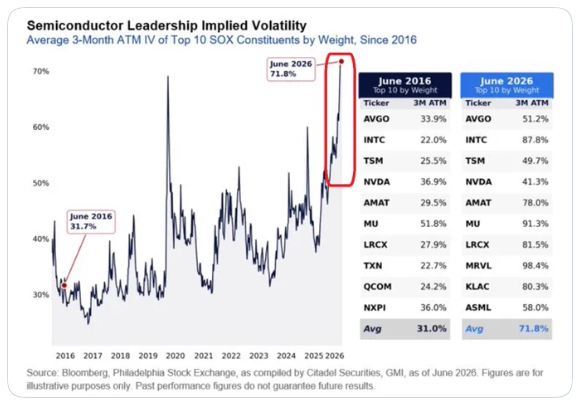
These outsized flows in an equity market segment which was relatively small just a few years ago are proving difficult to absorb. To this point, while the global equity markets have rarely experienced daily performance exceeding 2% up or down this year, semiconductor stocks are now routinely moving up or down 10% on no news. The chart below is from Citadel Securities. It tracks the implied volatility of a basket of semiconductor stocks using short term at the money options. The implied volatility is skyrocketing and exceeds the level witnessed during covid. This is happening despite the fact that business model fundamentals evolve far more gradually.
The enthusiasm extends beyond U.S. equities. At the time of writing this, SK Hynix, the South Korean chip industry leader, just raised over $25 billion to make it the largest American Depository Receipt (“ADR”) U.S. listing debut on record. Additionally, leveraged products tied to individual semiconductor stocks like SK Hynix have attracted record inflows. For example, the CSOP SK Hynix 2x ETF swelled to over $16 billion in market capitalization during the recent frenzy, briefly becoming the largest exchange-traded fund in all of Hong Kong. Such developments are not evidence of a market peak by themselves, but they are consistent with the later stages of powerful thematic investment cycles.
Since the beginning of the year, we have emphasized that relatively subdued index volatility has masked a growing divergence beneath the surface. While the market as a whole has appeared calm, the volatility of individual stocks has continued to rise.
The chart below from Bloomberg illustrates this widening gap. The CBOE S&P 500 Dispersion Index, which reflects the expected average volatility in individual stocks, has trended steadily higher even as implied volatility for the S&P 500 Index has remained relatively stable.
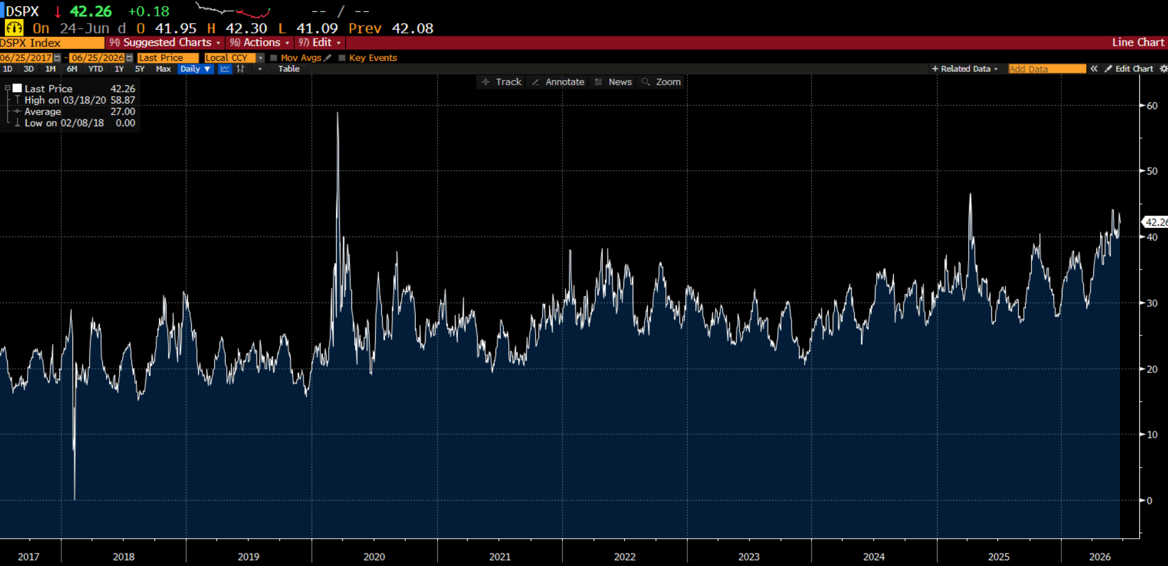
What ultimately breaks a cycle like this? Well, history suggests that investment booms rarely reverse because multiples become "too expensive" or that a trade has become “too crowded.” Instead, they tend to end when expectations surrounding future earnings change. For today's AI leaders, the obvious catalysts would include slower-than-expected hyperscaler capital expenditures, disappointing earnings, weaker guidance, or evidence that returns on massive AI investments are not materializing or will be postponed.
None of the above imply that AI adoption is ending. They simply suggest that markets may have become increasingly dependent on the assumption that current spending trajectories will continue indefinitely.
The important distinction for investors is that an AI-theme correction does not necessarily imply a broad market collapse.
During the unwinding of the dot.com bubble that began in 2000, technology stocks declined by roughly 55% over the following fifteen months. Yet the S&P 500 fell only 13%, while the non-technology portion of the market actually generated positive returns for more than a year after technology peaked. The dot.com bubble and the broader market proved to be two very different things. The same logic applies today. Even if the AI trade ultimately experiences a meaningful correction, it does not automatically follow that investors should abandon equities altogether. Rather, it reinforces the importance of ensuring that portfolios are not excessively dependent on a single theme whose success has increasingly become synonymous with index performance.
Our conclusion is unchanged. As market dispersion rises and traditional factor relationships become less reliable, diversification becomes more important, not less. The objective is not to predict precisely when enthusiasm surrounding AI will fade. It is to ensure that portfolios remain resilient, regardless of whether the next phase of the market is led by today's winners or by areas that have so far remained in their shadow.
And if AI falters, given that virtually every active equity manager has been underweight the AI theme for a range of reasons, should this cluster of stocks falter, the odds that they will collectively outperform seem decent to us, mathematically speaking. In other words, non-AI stocks may be a better hedge to AI stocks than other asset classes or instruments, like fixed income, or gold…
THE PITCHFORKS COMETH FOR AI SPOILS
The first phase of the AI revolution was technological. The second was financial. The next phase may well be political.
Artificial intelligence remains enormously popular in Silicon Valley and on Wall Street, but enthusiasm fades quickly outside those circles. At nearly every social gathering I attended this quarter, the conversation eventually turned to the same question: Will my children still have good jobs? That anxiety is becoming impossible for politicians to ignore.
The first signs are already emerging. New York has become the first state to impose a moratorium on large new data centres, citing concerns over electricity prices, water consumption, and pressure on local infrastructure. Georgia has considered similar restrictions, while Senator Bernie Sanders has called for a nationwide pause. Whatever the stated rationale, the underlying political message is simple: Voters are increasingly asking why households should bear higher utility bills to support the AI ambitions of a handful of technology companies and their executives.
If concerns about job displacement intensify, data-centre restrictions may prove to be only the beginning. It may not be at the forefront of the mid-term campaign, but we believe it will be key for the 2028 Presidential Election. It will become more polarizing. Perhaps we will see enthusiasts walk around with #ClaudeForPresident flyers while opponents picket in front of Anthropic’s headquarters…
A growing number of economists and policymakers have begun discussing ways to redistribute some of AI's economic gains. Proposals range from taxes on firms that replace workers with AI, to public ownership stakes in frontier AI companies, to "AI dividends" that would distribute a portion of the technology's productivity gains directly to households. Conceptually, it could resemble the Alaska Permanent Fund which redistributes to households oil and mineral royalties collected by the government.
Yanis Varoufakis, the economist and former minister of finance for Greece, has been reflecting on this for nearly ten years. His thesis is that society should establish a public claim on the returns generated by AI infrastructure itself rather than attempting to tax robots after the fact. He believes that taxing robots would discourage investment and create all sorts of disincentives that would harm productivity.
Whether any of these proposals are adopted is almost beside the point. Once a technology creates enormous wealth for a small group while many workers fear displacement, the political debate inevitably shifts from Can we build it? to Who should benefit?
For investors, the critical question is therefore not simply whether AI will eliminate jobs, but whether governments can respond quickly enough if it does. If labor displacement accelerates before policymakers have credible fiscal and social backstops in place, the result could be a sharp contraction in demand and a meaningful market correction. If, on the other hand, policy evolves alongside the technology, much of that risk can be mitigated.
Thank you for your continued support,
Patrimonica’s Investment Team
[1] Local currency returns unless specified otherwise
[2] An automatic 20-minute trading pause that occurs if the market declines by 8% during a session.
[3] Kevin Warsh is chair of the Federal Reserve and a member of the Federal Reserve Board of Governors since May 22,2026
[4] Comedy by William Shakespeare written in the late 16th century in which a great fuss is made of something insignificant through gossip, deception, and confusion.
[5] The 14-point document was mediated by Qatar and Pakistan, with Turkish support and Chinese approval.
[6] Political communication experts
[7] The Upside Down is a fictional parallel dimension in the Netflix seriesStranger Things. It mirrors the town of Hawkins, Indiana, in a frozen state and serves as a gateway to a hostile alternate realm known as the Abyss.
[8] The withdrawal clause. It states that any of the three countries can cancel its participation in the trade deal by giving a written notice. The withdrawal takes effect six months after that.
[9] Hyperscalers are large cloud service providers, which can provide services such as computing and storage at enterprise scale.